Ellery Eskelin's trio with Andrea Parkins and Jim Black has a unique and singular sound. Their sound is unlike that of any other working group in improvised music. Non traditional instrumental combinations are not uncommon in this genre, especially in more avant circles. Even the accordion - Parkins' main instrument in this trio - isn't unusual for mainstream or more freestyle jazz. From Richad Galliano, to Will Holshouser, to Evelyn Patrova, this much maligned instrument is getting its due. What happens with Parkins' electrified squeezebox is unlike anything else, though.
I'm always up for anything out of the ordinary, and I was immediately attracted to this trio when it started up in the mid '90s. Tenor sax, accordion + electronics, and drums will do the trick for me anytime. At times, Eskelin's trio can sound like an update on the tenor, organ, drums combination, with Parkins' electronic keyboards or accordion approximating the sound of the Hamond B3. That's where the comparisons end, however. Through years of working together, these three have developed a musical signature that, while it borrows from prog-rock, free-improvosation, eai, European classical music, and Bebop, cannot be classified.
This new recoding is from a concert held at Towson State University in Baltimore, Maryland on December 9, 2007. Eskelin is from Mobtown and received a degree in music at Towson, so this gig - coming at the tail end of a European tour - may have been a homecoming of sorts. I had the good fortune to be at the performance, and this recording is a great example of what this band is about.
It contains one new tune, "The Decider", the rest are from the previous recordings "Arcanum Moderne" and "Quiet Music." The tracks "Split the Difference" and "Instant Counterpoint", both from "Quiet Music", serve as excellent examples of this group's approach. "Split the Difference" starts out almost sounding like a traditional Jazz tune, with Eskelin and Parkins playing the theme and Black's swinging drums propelling things along. Eskelin plays one of his more inside solos, the theme returns and they quickly go off - Ellery solo, then a drum break, followed by and interesting dialog between Black, with Parkins adding a few comments here and there, all leading to a Black solo ending the tune. All through this, they never loose the thread of the original theme. Black may be one of the most gifted drummers around today, and he magically pulls all this together. "Instant Counterpoint" is based around a contrapuntal theme that's returned to over and over again. Between statements of the theme the musicians explore the various textures and colors that define this group's sound. Deep, almost subsonic, bass tones emerge from Parkins' accordion that, with a good subwoofer, will shake the floor a bit. Ellery's tenor playing on this is revelatory - out in the edge, but like other great players, he keeps it focused and on target, and with his cohorts, explores the dynamics to be discovered in the piece.
I'd recommend any of this group's recordings, but this one may be the best so far. Ellery will be happy to sell you a copy, so check out his Website. He also has titles from his back catalog available as well. Dive in and check this band out.
Sunday, October 18, 2009

Saturday, October 10, 2009
Bobby Bradford Quintet - 10/3/09
My last night in NYC I took in the Bobby Bradford Quintet at the Jazz Standard. I extended my stay one day just to see this band: Bradford on cornet, Marty Ehrlich on alto sax and clarinet, David Murray on tenor sax, Mark Dresser on bass and Andrew Cyrille on drums. If you're not familiar with this music it, just know that this is a lineup that is hard to beat.
Bradford is from LA and rarely makes it to NYC for a gig. This show was part of the "New Trumpet" festival that's been held at the Jazz Standard for the last few years. I think Bradford did make it out to one of the festivals a few years ago, though this was still a real treat for fans of improvised music in the city. Bradford is 75 now and has long been a central figure in the "outer" reaches of the jazz scene in Southern California. He played with Ornette Colemen in LA during the early 50's, prior to Don Cherry joining the quartet. He played again with Coleman in the early sixties in New York. Unfortunately, there are no recordings of Coleman with Bradford from this era.
Bradford moved back to LA where he eventually met and started working with reed player John Carter. This was to be the most important musical association of his career. He and Carter recorded a couple of fantastic albums for Flying Dutchmen in the late sixties, as well as a date for Revelation. These, like both Bradford and Carter, disappeared into obscurity, as Jazz as a marketable genre faded. Meanwhile, Bradford made a living as an educator and raised a family. Both he and Carter - along with Horace Tapscott- mentored a whole generation of players in Southern California. James Newton, and the above mentioned Murray and Dresser all count Carter and Bradford as their teachers. Bradford did, however, make it onto a few recordings in the 70's. A stay in London was prolific, resulting with a number of recordings with John Stevens. One of them, "Love's Dream", a quartet led by Bradford and featuring his compositions, has been reissued on the Enemem label. I'm still waiting for CD reissues of his recordings with Steven's Spontaneous Music Ensemble on Nessa. He also finally recorded with Ornette as part of the sessions Coleman did for Columbia that resulted in the albums "Science Fiction", "Twins", and "Broken Shadows."
It wasn't until the 80's when Carter - who by this time only played the clarinet - and Bradford started to get the attention they deserved with releases on the Moers, Black Saint and Gramavison labels. It's the four Gramavision records, released under Carter's name and featuring his music, that really gave both artists some level of popular and critical renown. I was fortunate to see a quartet of Carter, Bradford, Fred Hopkins and Cyrille in 1986, shortly after the first Gramavison LP , "Castles of Ghana", was released. This record took as its theme the castles on the coast of West Africa that were the embarkation points for African slaves being taken to the Americas. An octet - also including Marty Ehrlich - appeared on the LP, and Carter's music was beyond anything else I had heard before. Programmatic music usually leaves me cold, but this album, along with the other Octet albums on Black Saint and Gramavision, were inspiring and formative for me as a listener. The quartet I saw at the University of Virginia played some of the music from "Castles" and other pieces that Carter and Bradford had composed and played for years with their various groups in LA. It still counts as one of the most memorable performances I've experienced. Bradford and Carter went on to record an incredible live album for HatArt in 1989 and continued to work together until Carter's death in 1991. Since then, Bradford has recorded with David Murray, Vinnie Golia, Nels Cline and others, though I don't think there's been anything under his own name.
Bradford's cornet playing is earthy, full of slurs, and doesn't have the ringing, bell-like tone that's the typical signature of this horn. Armstrong is a clear influence, but Bradford is distinctly rooted in bebop and postbop. It's interesting to hear his playing alongside Don Cherry on the Coleman recordings. Bradford's grounded, focused solos contrast with the open, almost incantory playing of Cherry.
The other night all this was there on the stage - his unique voice and his deep knowledge and experience with this music. The band on stage was nonpareil. Murray's tone has become darker and more burnished over the years, though his Ayleresque flights at the height of his solo still bring an unearthly energy into the room. Ehrlich always sounds great, and he really dug into a great clarinet solo on "Woodsheditude." Dresser was the heart of this group and his playing was jaw dropping. Cyrille was, as usual, the perfect drummer for any situation. Bradford's stage presence was relaxed and funny. He's getting up there - "no spring chicken" in his words - but it was all really happening the other night.
Bradford is from LA and rarely makes it to NYC for a gig. This show was part of the "New Trumpet" festival that's been held at the Jazz Standard for the last few years. I think Bradford did make it out to one of the festivals a few years ago, though this was still a real treat for fans of improvised music in the city. Bradford is 75 now and has long been a central figure in the "outer" reaches of the jazz scene in Southern California. He played with Ornette Colemen in LA during the early 50's, prior to Don Cherry joining the quartet. He played again with Coleman in the early sixties in New York. Unfortunately, there are no recordings of Coleman with Bradford from this era.
Bradford moved back to LA where he eventually met and started working with reed player John Carter. This was to be the most important musical association of his career. He and Carter recorded a couple of fantastic albums for Flying Dutchmen in the late sixties, as well as a date for Revelation. These, like both Bradford and Carter, disappeared into obscurity, as Jazz as a marketable genre faded. Meanwhile, Bradford made a living as an educator and raised a family. Both he and Carter - along with Horace Tapscott- mentored a whole generation of players in Southern California. James Newton, and the above mentioned Murray and Dresser all count Carter and Bradford as their teachers. Bradford did, however, make it onto a few recordings in the 70's. A stay in London was prolific, resulting with a number of recordings with John Stevens. One of them, "Love's Dream", a quartet led by Bradford and featuring his compositions, has been reissued on the Enemem label. I'm still waiting for CD reissues of his recordings with Steven's Spontaneous Music Ensemble on Nessa. He also finally recorded with Ornette as part of the sessions Coleman did for Columbia that resulted in the albums "Science Fiction", "Twins", and "Broken Shadows."
It wasn't until the 80's when Carter - who by this time only played the clarinet - and Bradford started to get the attention they deserved with releases on the Moers, Black Saint and Gramavison labels. It's the four Gramavision records, released under Carter's name and featuring his music, that really gave both artists some level of popular and critical renown. I was fortunate to see a quartet of Carter, Bradford, Fred Hopkins and Cyrille in 1986, shortly after the first Gramavison LP , "Castles of Ghana", was released. This record took as its theme the castles on the coast of West Africa that were the embarkation points for African slaves being taken to the Americas. An octet - also including Marty Ehrlich - appeared on the LP, and Carter's music was beyond anything else I had heard before. Programmatic music usually leaves me cold, but this album, along with the other Octet albums on Black Saint and Gramavision, were inspiring and formative for me as a listener. The quartet I saw at the University of Virginia played some of the music from "Castles" and other pieces that Carter and Bradford had composed and played for years with their various groups in LA. It still counts as one of the most memorable performances I've experienced. Bradford and Carter went on to record an incredible live album for HatArt in 1989 and continued to work together until Carter's death in 1991. Since then, Bradford has recorded with David Murray, Vinnie Golia, Nels Cline and others, though I don't think there's been anything under his own name.
Bradford's cornet playing is earthy, full of slurs, and doesn't have the ringing, bell-like tone that's the typical signature of this horn. Armstrong is a clear influence, but Bradford is distinctly rooted in bebop and postbop. It's interesting to hear his playing alongside Don Cherry on the Coleman recordings. Bradford's grounded, focused solos contrast with the open, almost incantory playing of Cherry.
The other night all this was there on the stage - his unique voice and his deep knowledge and experience with this music. The band on stage was nonpareil. Murray's tone has become darker and more burnished over the years, though his Ayleresque flights at the height of his solo still bring an unearthly energy into the room. Ehrlich always sounds great, and he really dug into a great clarinet solo on "Woodsheditude." Dresser was the heart of this group and his playing was jaw dropping. Cyrille was, as usual, the perfect drummer for any situation. Bradford's stage presence was relaxed and funny. He's getting up there - "no spring chicken" in his words - but it was all really happening the other night.
Monday, October 05, 2009
John Abercrombie Quartet at Birdland
I made it to the 11 PM show on Friday October 2, 2009 to hear John Abercrombie's long lived quartet. Working groups like this one are relatively rare in Jazz, mostly, I suppose, due to the economics of this art form. The quartet of Abercrombie on guitar, Mark Feldman on violin, Thomas Morgan on bass - bassist Mark Johnson having moved on - and Joey Baron on drums, was in the middle of an engagement at Birdland, and promoting the release of their new CD, "Wait Till You See Her". I've only heard "Class Trip," the second of their four CDs, all on ECM, and had been really impressed by this group. Abercrombie has a long discography - I've been listening to him since his first album, "Timeless", came out in the mid-Seventies - and it was clear that with this group he was still putting himself in challenging musical situations. Feldman is a fine improvising violinists and Baron, a killer drummer, and both musicians have a good deal of downtown creditability, having played in various John Zorn-associated groups - for whatever that's worth. Mark Johnson, who played on the first three recordings, made his name playing with Bill Evans, and is a fine, melodic and tasteful player. Thomas Morgan is new to me, but he obviously fits in well with these veterans.
They played "Banshee" from an earlier CD, a couple of pieces from the new one, the title cut from "Class Trip", and ended with a great take on Ornette Coleman's "Round Trip." I liked this a lot. They eased into a statement of the tune's head and then Baron went in to a solo that lead into the group playing a bluesy groove that had some hints of "Dance of the Maya" by The Mahavishnu Orchestra. Ornette's theme came back in a few more times, with Feldman perfectly capturing the playful melody. Other quotes - "How High the Moon?", "Break Tune" - crept in here and there before they brought it all to an end.
Abercrombie isn't a flashy player. He has at times a light, airy tone with the signature hint of echo that the ECM label is famous for. At other times he has an quiet intensity to his playing. Like all great players, his sound is unique and immediately recognizable, and this comes across very well in a live setting. I think that this group may be the best of his career. Baron is a solid jazz player and his drumming really lights a fire under this group. Feldman, with his mostly vibrato-less tone, and flawless technique is a joy to listen to. I can't think of too many jazz violinists that can play at this level.
A great show. Check these guys out if you have a chance.
They played "Banshee" from an earlier CD, a couple of pieces from the new one, the title cut from "Class Trip", and ended with a great take on Ornette Coleman's "Round Trip." I liked this a lot. They eased into a statement of the tune's head and then Baron went in to a solo that lead into the group playing a bluesy groove that had some hints of "Dance of the Maya" by The Mahavishnu Orchestra. Ornette's theme came back in a few more times, with Feldman perfectly capturing the playful melody. Other quotes - "How High the Moon?", "Break Tune" - crept in here and there before they brought it all to an end.
Abercrombie isn't a flashy player. He has at times a light, airy tone with the signature hint of echo that the ECM label is famous for. At other times he has an quiet intensity to his playing. Like all great players, his sound is unique and immediately recognizable, and this comes across very well in a live setting. I think that this group may be the best of his career. Baron is a solid jazz player and his drumming really lights a fire under this group. Feldman, with his mostly vibrato-less tone, and flawless technique is a joy to listen to. I can't think of too many jazz violinists that can play at this level.
A great show. Check these guys out if you have a chance.
Friday, October 02, 2009
Evan Parker at The Stone
I was fortunate to be in NYC this week for business and able to attend the first night of Evan Parker's 2-week residency at The Stone. The English saxophonist is here to play with just about everyone in New York in a series of duets, trios and larger groupings at John Zorn's performance space in the Lower East Side. Last night, Parker kicked it off with a solo set.
If you're not familiar with Parker, he has developed a unique vocabulary for solo performance on both the soprano and tenor saxophones based, partly, on circular breathing techniques. He manages to take what could just be a gimmick and turn it into a basis for expressive improvisation. The solos he played last night were what I've come to expect. His explorations with the soprano are focused, intense and based around cyliclic rhythmic ideas, with interesting overtones and colors emerging from his constant, circular breathing. The solos on tenor tend to be less fiery, and tend to explore the tonal colors of the instrument, the mechanical clicking of the horn's keys, space and silence. The circular breathing is here too, but often, you get a kind of melodicism and a sense of a phrasal line. Parker ended the set with a short soprano solo based around Steve Lacy's composition, "Hubris." This gave a taste of Parker's versatility beyond his own original approach.
I'm not doing what I heard justice, I suppose, and my lack of expository skill and musical knowledge forces me to make up jargon like "phrasal line." Just go on Youtube and search on "Evan Parker solo" or buy any of the numerous recordings of his solo playing. "Conic Sections" on the Ah-Um label (now reissued on Psi) is a good one to start with. It's all soprano solos, so you'll have to seek out his recorded work on solo tenor elsewhere.
The solo set was followed by a set with synthesist Richard Teitelbaum. They had never performed together before, though have known each other for years - going back to Teitelbaum's work with Musica Elettronica Viva in the 60's and 70's. Both players showed themselves to be masters of free improvisation and carried on an interesting musical conversation for about an hour. Teitelbaum's synth work never overwhelmed Parker's sound, and Parker didn't betray that fact that he has just been the soul focus of attention during the previous solo set. It was a a quiet, almost reflective set of music.
If you're not familiar with Parker, he has developed a unique vocabulary for solo performance on both the soprano and tenor saxophones based, partly, on circular breathing techniques. He manages to take what could just be a gimmick and turn it into a basis for expressive improvisation. The solos he played last night were what I've come to expect. His explorations with the soprano are focused, intense and based around cyliclic rhythmic ideas, with interesting overtones and colors emerging from his constant, circular breathing. The solos on tenor tend to be less fiery, and tend to explore the tonal colors of the instrument, the mechanical clicking of the horn's keys, space and silence. The circular breathing is here too, but often, you get a kind of melodicism and a sense of a phrasal line. Parker ended the set with a short soprano solo based around Steve Lacy's composition, "Hubris." This gave a taste of Parker's versatility beyond his own original approach.
I'm not doing what I heard justice, I suppose, and my lack of expository skill and musical knowledge forces me to make up jargon like "phrasal line." Just go on Youtube and search on "Evan Parker solo" or buy any of the numerous recordings of his solo playing. "Conic Sections" on the Ah-Um label (now reissued on Psi) is a good one to start with. It's all soprano solos, so you'll have to seek out his recorded work on solo tenor elsewhere.
The solo set was followed by a set with synthesist Richard Teitelbaum. They had never performed together before, though have known each other for years - going back to Teitelbaum's work with Musica Elettronica Viva in the 60's and 70's. Both players showed themselves to be masters of free improvisation and carried on an interesting musical conversation for about an hour. Teitelbaum's synth work never overwhelmed Parker's sound, and Parker didn't betray that fact that he has just been the soul focus of attention during the previous solo set. It was a a quiet, almost reflective set of music.
Saturday, January 03, 2009
Nicole Michell's Black Earth Ensemble - Xenogenesis Suite
 Nicole Michell's Black Earth Ensemble Xenogenesis Suite - A Tribute To Octavia Butler
Mankwe Ndosi - vcl; David Young - tp; Nicole Mitchell - flt; David Boykin - ts; Tomeka Reid - cel; Justin Dillard - p; Josh Abrams - b; Marcus Evans - d; Avreeayl Ra - perc
Firehouse 12 Records
Recorded June 20, 2007 at Firehouse 12 in New Haven, CT
Chicago's Nicole Michell brings us a troubling and searing piece of music dedicated to the work of the late novelist Octavia Butler. This music is in the tradition of the Association for the Advancement of Creative Musicians (AACM), a 40 year old institution whose formation represented Chicago's reaction to the mostly New York-based Jazz Avant Guard of the 60s. Mitchell continues in the tradition of Anthony Braxton, Henry Threadgill, Muhal Richard Abrams and Roscoe Mitchell and demonstrates that the AACM's original vision remains vital.
The playing here is impecable and Nicole's careful weaving of composed and improvised passages never misses its mark. This is ensemble music, and while it's clear that everyone involved is an accomplished soloist, the group sound is the real point. Ndosi's vocals are integral part of this sound and as jarring as the vocal effects are, her musicality comes through. If you want a challenging, and maybe to uninitiated ears, confounding, listen, then check this one out.
Friday, December 26, 2008
Music of 2008 - Reissues
There's been a lot of great new music in 2008, though I thought I'd start with some impressions of reissues that came my way.
 Jack DeJohnette - Special Edition
Arthur Blythe - as
David Murray - ts, bcl
Peter Warren - bass
Jack DeJohnette - drums
ECM 1152
Recorded March, 1979 in New York City
My introduction to Jazz, like many others growing up in the '70s, was through Jazz-Rock, an awful, pejorative term, mostly, but it was the bait for a lot of people in getting into the music. I'd taken to DeJohnette's Directions band mostly due to the buzz around John Abercombie, and comparisons of his playing to McLaughlan, the guitar god of the day. In retrospect, the comparisons were critical BS, Abercombie's playing owing more to then unsung players like Jim Hall. DeJohnette, however, through a wrench into our fret counting, guitar wanking expectations by putting out New Directions in 1978 with Lester Bowie on trumpet, Abercombie and Eddie Gomez on bass. The combination of Abercombie's reverbed out electric mandolin and Bowie's flatuious playing pricked up my addled ears, so I was ready by the time Special Edition came out in 1980.
I was largly ignorant of the black avant guarde of the 60's. I'd heard of Ornette Coleman, mostly through the version of "Broadway Blues" on Pat Metheny's Bright Sized Life, another vintage ECM record. I'd also heard of Coltrane, but had not really heard him. I had no knowledge of Cecil Taylor, Shepp, Ayler or any of the other luminaries of the New Thing. By the time I was paying attention, the one Jazz radio station I knew of, WRVR in New York, was staying as far away as possible from that stuff. Other people my age, white and black, were into Funk, Prog or the above mentioned Jazz Rock, so I had little chance for exposure to this stuff. Add to that my move from the New York area to South Eastern Outer Bumfuck after graduation from High School, and any chances beyond hearing 38 Special or REO were gone. Thank god ECM had a good distribution deal with Warner.
When I first heard Special Edition, I had never heard of David Murray or Arthur Blythe. I didn't know who Eric Dolphy was either, the Eric in the opening tune, One For Eric. I'd never heard anything like this before. DeJohnette's odd contrasting meters in the theme of the tune, Murray's bass clarinet invoking Dolphy's intervallic approach, and Blythe's beautiful, swinging alto all made this tune a true inflection point in the way I heard music. The next tune, Zoot Suite, start's with Warren's killer bass introduction and a funny, swinging ostinato involving Blythe and DeJohnette on melodica, followed by an great, representative Murray solo on bass clarinet. This is followed by a slower middle section with winds and bowed bass and a return to the original theme with DeJohnette kicking in on the drums. Two Coltrane tunes follow, Central Park West and India (the second call out to Dolphy, since Eric played bass clarinet on the original recording with 'Trane at the Vanguard in 1961). Central Park West is taken with just the horns, and bowed bass. India is introduced by DeJohnette's piano and features some great playing from both Blythe and Murray. The album ends with Journey it the Twin Planet, a great out, swinging blowout with Blythe and Murry digging in for extended simultaneous soloing with Warren and DeJohnette digging in right underneath, an abrupt ending into Murray's pleading tenor and a brief spacey, repeated figure ending the piece.
This was, I think, a culmination of sorts for DeJohnette. I really don't feel like any of his other recordings for ECM reached these heights. It seems like the reputations and visibility of Murray and Blythe were enhanced. Murray was at the cusp of recording the seminal Ming with his octet on Black Saint, and Blythe was at the beginning of his association with Columbia, which resulted in some great, classic recordings. Blythe's recorded sound, however, was always much more pleasing on this recording than on the Coulmbia. Special Edition was recorded in New York and produced by DeJohnette, so it doesn't have that falling into a fiord sound that ECM's are famous for. This is also much different from the freer work that Murray had been recording at the time for Black Saint, India Navigation and other labels. DeJohnette created here some beautiful structures that really showed off his own creativity and that of Murray and Blythe. Peter Warren's playing in this is fantastic. Other than the second Special Edition record, Tin Can Alley, and a date he led for the Japo label, I don't know where he's gone to.
This release is part of ECM's Touchstone series which are being sold cheap, so pick this one up.
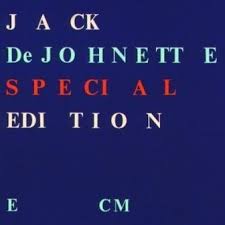 Jack DeJohnette - Special Edition
Arthur Blythe - as
David Murray - ts, bcl
Peter Warren - bass
Jack DeJohnette - drums
ECM 1152
Recorded March, 1979 in New York City
My introduction to Jazz, like many others growing up in the '70s, was through Jazz-Rock, an awful, pejorative term, mostly, but it was the bait for a lot of people in getting into the music. I'd taken to DeJohnette's Directions band mostly due to the buzz around John Abercombie, and comparisons of his playing to McLaughlan, the guitar god of the day. In retrospect, the comparisons were critical BS, Abercombie's playing owing more to then unsung players like Jim Hall. DeJohnette, however, through a wrench into our fret counting, guitar wanking expectations by putting out New Directions in 1978 with Lester Bowie on trumpet, Abercombie and Eddie Gomez on bass. The combination of Abercombie's reverbed out electric mandolin and Bowie's flatuious playing pricked up my addled ears, so I was ready by the time Special Edition came out in 1980.
I was largly ignorant of the black avant guarde of the 60's. I'd heard of Ornette Coleman, mostly through the version of "Broadway Blues" on Pat Metheny's Bright Sized Life, another vintage ECM record. I'd also heard of Coltrane, but had not really heard him. I had no knowledge of Cecil Taylor, Shepp, Ayler or any of the other luminaries of the New Thing. By the time I was paying attention, the one Jazz radio station I knew of, WRVR in New York, was staying as far away as possible from that stuff. Other people my age, white and black, were into Funk, Prog or the above mentioned Jazz Rock, so I had little chance for exposure to this stuff. Add to that my move from the New York area to South Eastern Outer Bumfuck after graduation from High School, and any chances beyond hearing 38 Special or REO were gone. Thank god ECM had a good distribution deal with Warner.
When I first heard Special Edition, I had never heard of David Murray or Arthur Blythe. I didn't know who Eric Dolphy was either, the Eric in the opening tune, One For Eric. I'd never heard anything like this before. DeJohnette's odd contrasting meters in the theme of the tune, Murray's bass clarinet invoking Dolphy's intervallic approach, and Blythe's beautiful, swinging alto all made this tune a true inflection point in the way I heard music. The next tune, Zoot Suite, start's with Warren's killer bass introduction and a funny, swinging ostinato involving Blythe and DeJohnette on melodica, followed by an great, representative Murray solo on bass clarinet. This is followed by a slower middle section with winds and bowed bass and a return to the original theme with DeJohnette kicking in on the drums. Two Coltrane tunes follow, Central Park West and India (the second call out to Dolphy, since Eric played bass clarinet on the original recording with 'Trane at the Vanguard in 1961). Central Park West is taken with just the horns, and bowed bass. India is introduced by DeJohnette's piano and features some great playing from both Blythe and Murray. The album ends with Journey it the Twin Planet, a great out, swinging blowout with Blythe and Murry digging in for extended simultaneous soloing with Warren and DeJohnette digging in right underneath, an abrupt ending into Murray's pleading tenor and a brief spacey, repeated figure ending the piece.
This was, I think, a culmination of sorts for DeJohnette. I really don't feel like any of his other recordings for ECM reached these heights. It seems like the reputations and visibility of Murray and Blythe were enhanced. Murray was at the cusp of recording the seminal Ming with his octet on Black Saint, and Blythe was at the beginning of his association with Columbia, which resulted in some great, classic recordings. Blythe's recorded sound, however, was always much more pleasing on this recording than on the Coulmbia. Special Edition was recorded in New York and produced by DeJohnette, so it doesn't have that falling into a fiord sound that ECM's are famous for. This is also much different from the freer work that Murray had been recording at the time for Black Saint, India Navigation and other labels. DeJohnette created here some beautiful structures that really showed off his own creativity and that of Murray and Blythe. Peter Warren's playing in this is fantastic. Other than the second Special Edition record, Tin Can Alley, and a date he led for the Japo label, I don't know where he's gone to.
This release is part of ECM's Touchstone series which are being sold cheap, so pick this one up.
Wednesday, November 05, 2008
Obama!!!
I spent all day yesterday in Woodbridge, VA getting out the vote. It feels great having been a part of this.
Subscribe to:
Posts (Atom)